Your home organization system is probably failing for one specific reason: it was designed for your best days, not your worst ones.
If you've got bins, baskets, and labels but still can't keep a clear counter, this guide is for you. The tools aren't failing you. The structure behind them needs a rethink.
The fix isn't a new method, a new product, or a dedicated weekend project. It's redesigning around how you live on the hardest days, not the easiest ones.
Home organization for everyday comfort works when it holds up under pressure. Let's look at how to build that.
Stop Organizing for Your Best Self
Most organizational advice assumes you'll have the time, energy, and focus to maintain your system every single day. That assumption is exactly why most systems fall apart within a month.
The version of you that sets up the system is usually well-rested, motivated, and ready to tackle everything. The version who has to maintain it is often tired, pressed for time, or just done.
The Real Reason Your System Keeps Collapsing
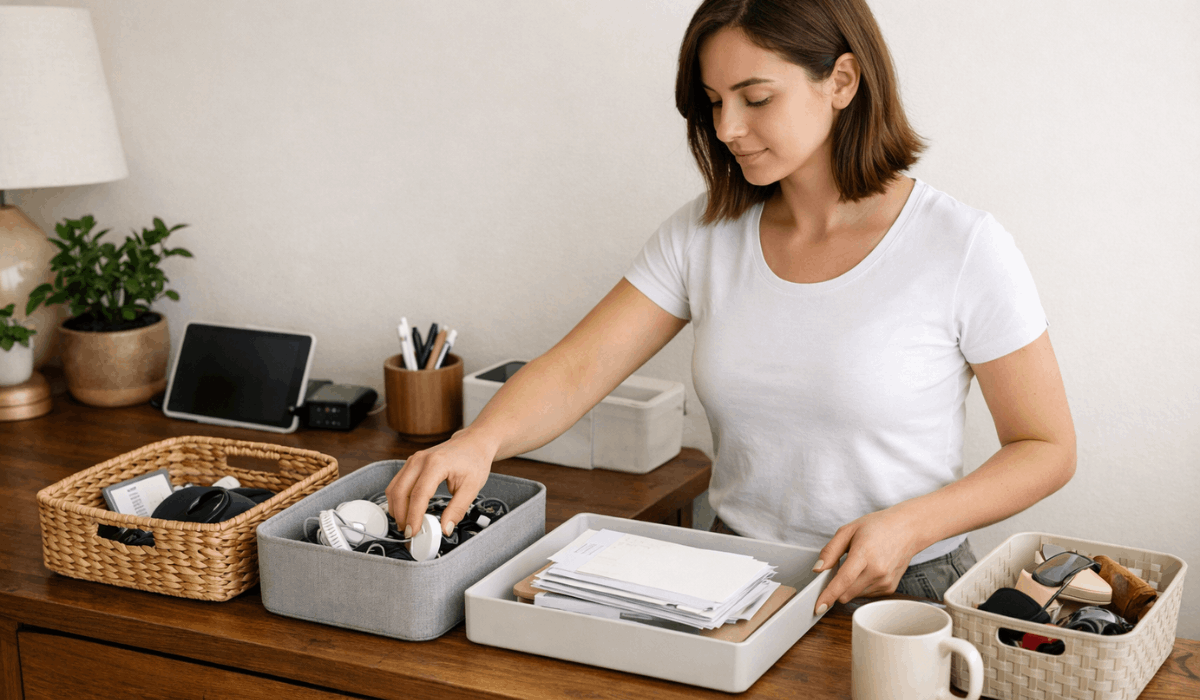
Organization that requires consistent motivation will always break down eventually. The fix is designing your storage for low effort, not low clutter. Open bins and trays instead of lids and multi-step containers.
If putting something away takes more than a few steps, it won't happen consistently.
Fewer decision points matter enormously here. Decision fatigue is a real cognitive issue: the more choices you face, the worse your judgment gets by the end of the day.
A storage system with too many hyper-specific categories creates friction every single time you use it. And friction is exactly what kills consistency.
Also read: Home Organization for People Who’ve Already Tried (and Watched It Fall Apart Again)
Design for the Version of You Who's Exhausted
My take on the best home organization test: if putting something away takes more than a few steps, it will fail the moment you're tired or rushed. That's the design constraint most guides completely ignore.
Place items where they naturally land, not where they theoretically belong. If your keys always end up on the kitchen counter, put a tray on the kitchen counter. Stop fighting the habit. Support it.
This approach changes the entire relationship between you and your space. A system that adapts to your real behavior gets used. A system that fights it gets abandoned.
The Frequency Rule Changes Everything
An organizing principle that most guides consistently underplay: where you store something should be decided entirely by how often you use it. Not by what category it belongs to. Not by its size.
That kitchen gadget you reach for daily belongs at eye level, within arm's reach, with no lid required. The bread maker you pull out seasonally can live on a high shelf.
Every second spent searching for something, every extra step to reach it, is friction. Multiply that across an entire day, and you understand why some homes feel effortless and others feel draining.
Keep Daily Items in Prime Real Estate
Prime storage space is limited. Most people waste it on items that look organized but aren't used that often. A simple audit by frequency of use:
- Daily items: eye level, within arm's reach, open storage, no lids
- Weekly items: accessible drawers or secondary shelves are fine
- Seasonal items: high shelves, backs of closets, labeled bins
If an item is always left out on a surface, that's not a sign of messiness. It's data. The item needs a closer, more accessible home.
The Insight Most Organization Guides Skip Entirely
Honestly? I think frequency of use is the single most overlooked organizing principle. Most guides jump straight to aesthetics and categories.
Meanwhile, your daily-use items stay buried in back drawers while prime shelf space holds seasonal things you touch maybe twice a year.
Organize by frequency first. Let every other storage decision follow from that.
Over-Labeling Is Silently Killing Your System
Most guides will tell you to label everything and create detailed categories, sorted by type.
I think excessive categorization is one of the main reasons organized homes fall apart. Too many decision points at the moment of putting something away makes the system hard to maintain when energy is low.
Do the scissors go in "Office Supplies" or "Craft Tools"? That question is the problem. Hesitation is friction, and friction kills daily consistency.
| Feature | Complex System | Simple System |
|---|---|---|
| Number of categories | Many, hyper-specific | Few, broad |
| Storage style | Labeled, lidded containers | Open bins and trays |
| Reset time | Several minutes | One to two minutes |
| Works on low-energy days | Rarely | Consistently |
| Requires ongoing motivation | Yes | Rarely |
Simple systems require less daily mental effort to use, which means they stay functional across a much wider range of days and energy levels.
Simpler Categories Get Used More Often
Fewer categories mean fewer decisions at the moment of putting something away. The test: can you return an item without pausing to think about which bin it belongs in? If yes, the categories are working.
One container should have one clear role. Grouping by function works better than grouping by type. "Everything we use to make dinner" outperforms three separate bins labeled "Kitchen Utensils," "Cooking Tools," and "Gadgets" every time.
These are signs your categories have gotten too complicated:
- Items pile up on surfaces because no existing bin feels quite right
- Others in your home can't figure out where things go
- Putting things away feels like a logic puzzle
- Bins consistently overflow into neighboring sections
Cut the number of categories roughly in half if any of those sound familiar. The improvement tends to be immediate.
Reset Zones: Is the Shortcut Worth Building
A reset zone is one of the most practical organizing ideas available. And most people have never set one up intentionally.
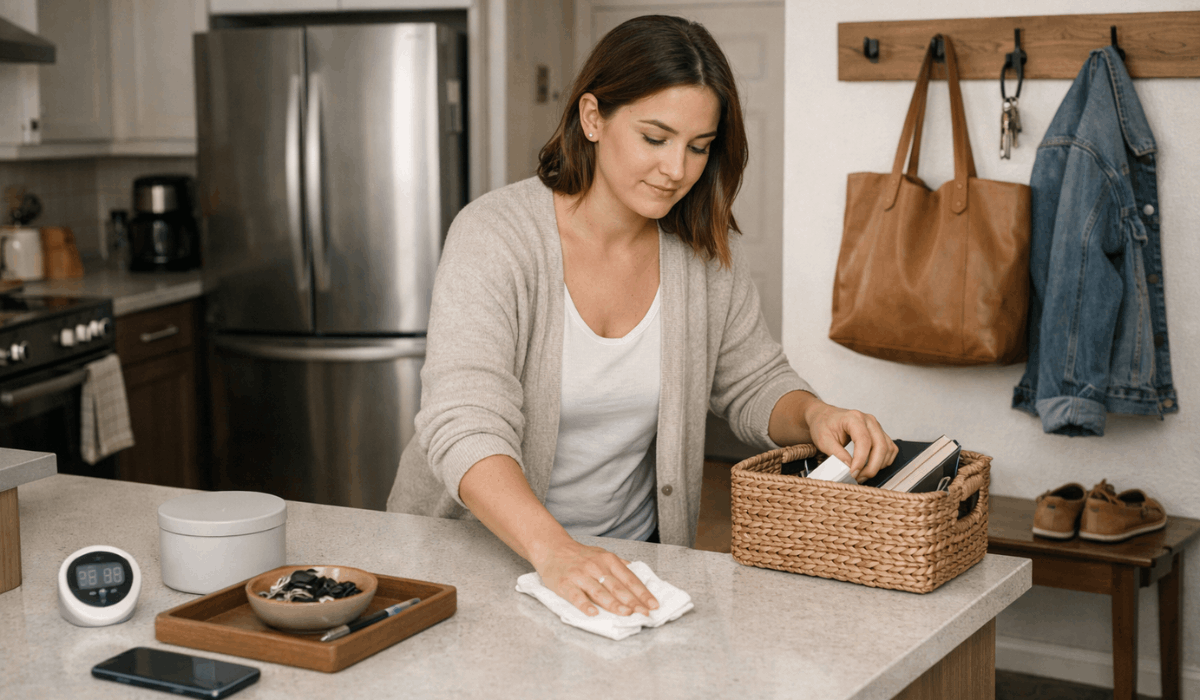
The concept: visible, designated spots where daily-use items land so they're easy to return without thought. An entryway tray for keys, bags, and shoes. A small basket in the living room for remotes and chargers. A counter spot for whatever gets carried in from outside.
How to Build a Reset Zone That Holds
Each zone needs one clear purpose and should be clearable in under two minutes. That limit matters. If clearing a reset zone takes longer, the zone is too large or too complicated.
Open storage beats closed storage for reset zones every time. Putting something away needs to feel automatic, which means removing the extra step of opening a lid, a drawer, or a door.
Reset zones don't just reduce clutter. They change how a space feels emotionally. A room with clear landing spots feels easier to manage even on days when nothing else is organized.
Visual Noise Makes Rooms Feel Worse Than They Are
A space can look completely organized and still feel stressful. That's the part most home organization content skips entirely.
Visual clutter, meaning too many objects in your line of sight at once, creates mental load even when everything is technically in place. The American Psychological Association connects cluttered environments to sustained stress and reduced mental clarity.
What "Organized but Stressed" Actually Looks Like
This was a turning point for me: once I started limiting open-surface items to daily-use only, the evening reset dropped to under two minutes. The visual shift made the room feel noticeably calmer to be in.
The fix is reducing what's visible. Keep only daily-use items on open surfaces. Group similar items consistently so the eye can scan without effort. Clear edges and corners. Use closed or neutral-toned storage for anything that adds visual noise.
Reducing what's visible on surfaces often creates a calmer feeling than deep cleaning does.
Building Systems That Survive Real Life
The most durable organization systems flex with you. Routines shift. Seasons change. Energy fluctuates. A rigid system cracks under those pressures. A flexible one adapts.
Most people do a full reorganization when a system fails. But a system rarely needs to be rebuilt from scratch. It usually just needs one small update in the right spot.
When to Adjust Instead of Starting Over
Watch for these signals that a system needs a small update rather than a full overhaul:
- The same item keeps landing in the wrong spot repeatedly
- One area collects clutter faster than anywhere else in the house
- A storage solution feels like it's working against your routine
The fix in each case is targeted: move one thing, swap one container, adjust one habit at a time. Small adjustments are far easier to sustain than full reorganizations, and they're usually all you need.
Seasonal Shifts Without Weekend Projects
Seasons change what needs easy access. The goal is swapping reach, not adding more storage.
Rotate what sits at the front of the shelves. Move seasonal items to harder-to-reach spots when they're not in regular use. Update entryways and closets to match what you're currently wearing and carrying.
These are five-minute adjustments. Keeping them small is exactly how they get done instead of endlessly postponed.
Questions People Ask About Home Organization
Q: How do I stay organized when I'm too tired to maintain a system? Motivation is the wrong target. Build systems that work without it. Open bins, visible reset zones, and broad categories require almost no motivation to use. When putting something away takes one step, it tends to happen automatically.
Q: How many storage categories should I have? Fewer than you think. Most rooms function well with just a handful of broad categories. The real test: can anyone in your house put something away without asking where it goes? If not, simplify.
Q: What exactly is a reset zone? A reset zone is a visible, dedicated spot where daily-use items land so they're easy to return without much thought. An entryway tray, a living room basket. Each zone should clear in under two minutes. If surfaces in your home always collect clutter, a reset zone replaces the pile with a system.
Q: Why does my home feel messy even after I tidy it? This is almost always a visual noise issue. Too many items in your line of sight, even organized ones, create mental load. Reducing what's visible on surfaces tends to have a bigger impact on how a room feels than most traditional cleaning tasks do.
Q: How do I know when my organization's system needs updating? Watch for friction. If the same spot keeps collecting clutter or the same item keeps ending up in the wrong place, that's the signal. Targeted small adjustments usually fix it without a full overhaul required.
Conclusion
Start with one room. Pick the space that frustrates you most, find the single spot where clutter collects fastest, and create a reset zone there.
One tray, one basket, one clear purpose, clearable in under two minutes. Get that working first, and the rest of the home starts to feel genuinely possible.