Most people reorganize their home and feel great for about four days. Then life happens, the pile comes back, and the “system” quietly collapses. Sound familiar?
The problem is rarely laziness. It’s that most home organization advice is built for someone who already has their act together. This is for the person who doesn’t.
If your mornings feel chaotic, your counters collect mystery piles, and you’ve bought the same item twice because you couldn’t find the first one, this is exactly where to start.
No aesthetic overhauls. No color-coded pantry. Just a smarter way to think about how your home actually works.
Stop Asking “Is My Home Organized?” and Start Asking This Instead
The question most people ask is wrong. “Is my home organized?” leads to comparison spirals and a $200 trip to a container store that fixes nothing.
The better question: where does my day slow down?
That’s what functional actually means. A functional home reduces friction in daily routines. It’s measurable. It shows up in how fast you can start tasks, finish them, and reset spaces without thinking hard.
Find Your Three Friction Points First
I think skipping this step is the single reason most reorganization projects fail within two weeks. People fix the wrong things.
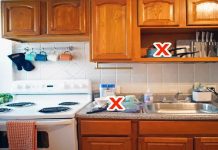
Walk through your day and notice the three moments that regularly frustrate you. Maybe it’s hunting for keys every morning. Maybe it’s cooking dinner while dodging stuff on the counter. Maybe it’s the pile of mail that’s been “temporary” since February.
Those three moments are your highest-return fixes. Not the linen closet. Not the garage. Those three things.
Also read: Simple Home Organization Routines for Beginners Who’ve Tried Everything Else
Give Each Room One Job
A room that tries to do everything often does nothing well. Pick a primary purpose for each space, then list three measurable outcomes that matter to you specifically.
For a kitchen, that might look like:
- Clear counter space for actual food prep
- One drawer that holds only the tools you use daily
- A system where cooking utensils live next to the stove, not in a random drawer across the room
Resist the urge to add more storage solutions until those three outcomes stay stable for two full weeks. Stability first, expansion later.
Build Zones Around What You Already Do
This is the part most people skip. And it explains why beautiful organization systems fall apart fast.
Most advice groups things by category, like putting all batteries together, all office supplies together, all cleaning products together. My take on this is that categories are for stores, not homes.
Zones built around your actual routines beat category-based systems almost every time.
A routine-based zone groups actions together. Unpacking groceries. Getting out the door in the morning. Charging devices overnight. Each zone has a clear start and stop point, and everything you need for that action lives there.
Build an Entryway That Works Like a Pit Stop
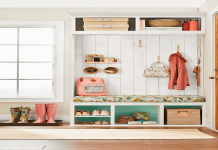
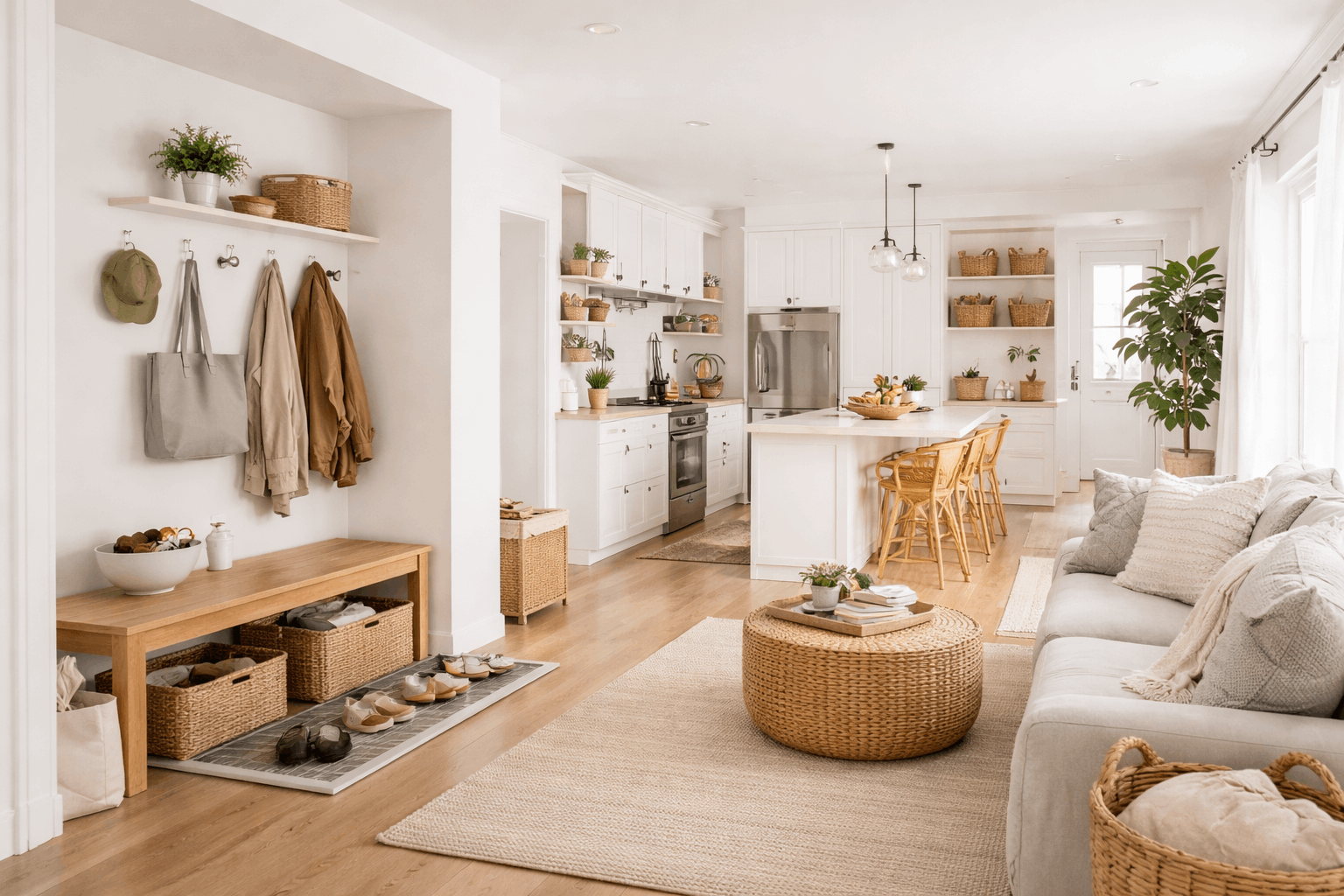
Your entryway is the highest-traffic zone in the house. A few targeted changes here will improve your morning routine faster than reorganizing any other room.
Use one hook area for bags and jackets. Hanging beats stacking when you are rushing.
Add a small tray or bowl specifically for keys and cards, because tiny essentials need a permanent landing spot, not a rotating “I’ll put it here for now” situation. A shoe tray or mat at the boundary keeps dirt contained and sets a physical limit.
I tried this myself, and the key problem alone reduced my average morning scramble significantly. It sounds almost too simple. But it works because it removes the decision, not just the mess.
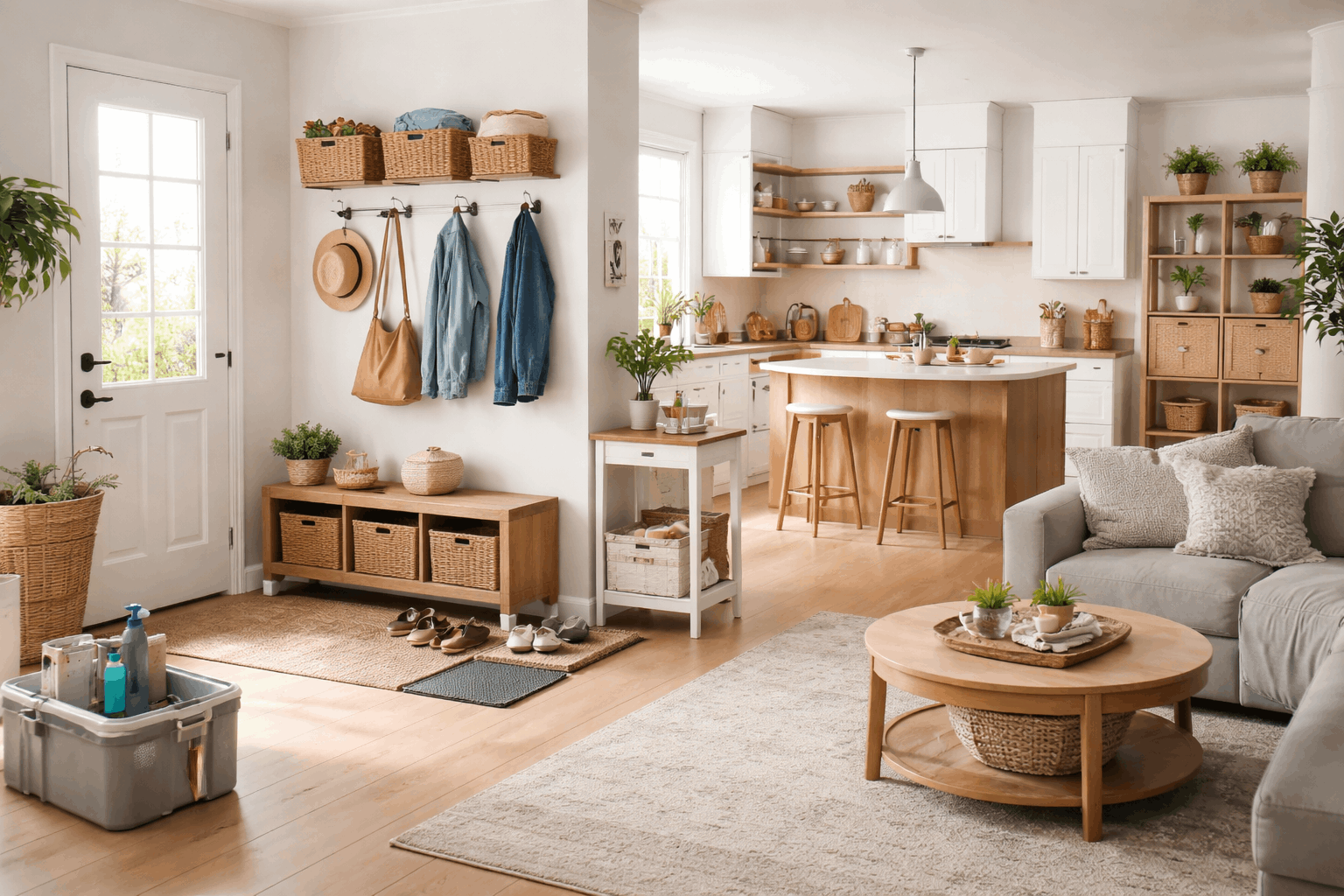
Set Up a Kitchen That Stops Fighting You
Keep daily tools near where you actually use them. Cutting boards near the prep area. Utensils near the stove. This sounds obvious until you realize how many kitchens are set up the opposite way because someone organized by “type” instead of by workflow.
One dedicated drawer for everyday items means you stop digging past the fondue set to find a spatula. And clear one counter section on purpose. An open work surface is what makes cooking and cleaning faster, not another gadget.
Container Limits Are the Only Clutter System That Holds
Clutter doesn’t grow because people are messy. It grows because there is unlimited space for “just for now” piles. The pile doesn’t have a wall to stop it, so it doesn’t stop.
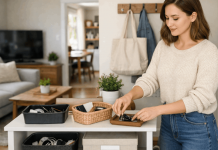
Container limits create that wall. A full bin forces a decision before the mess spreads. One bin for cables. One basket for daily grab items. One tray for incoming mail.
The One-In-One-Out Rule Sounds Simple Because It Is
Pick one open bin for cables. When it’s full, you remove extras before adding new ones. That’s it. The limit only works when it stays firm, which means the discipline is maintaining the container, not creating a perfect system.
For paper specifically: use one tray for incoming mail, create a “needs action” spot so papers with a next step don’t disappear into the pile, and schedule a weekly sort. Small paper piles become major stress when they sit for two or three months unchecked.
Unpopular opinion, maybe, but I’d argue that most people don’t need a filing system at all. According to research on decision fatigue, the more categories and micro-labels you create, the less likely you are to maintain them when you’re tired.
Broad groups like “batteries,” “tools,” and “first aid” outlast elaborate systems because they match real behavior, not ideal behavior.
Multi-Functional Spaces Without the Chaos
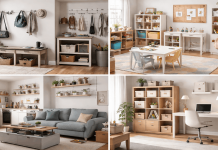
A multi-functional home works when flexibility is built in through smart furniture choices, not when every corner becomes a DIY project.
One strong table that handles dining and homework beats two crowded surfaces. A fold-away desk or wall shelf provides workspace without permanently eating up floor space. The key is giving every flexible item a “home base” where it returns after use.
Portable Kits Change How Cleaning Feels
I’ve always believed that the friction of finding supplies is what makes tasks feel bigger than they are. A cleaning kit that stays together, stored where you actually clean, removes that friction completely.
The same logic applies to a small repair kit: scissors, tape, batteries, and a screwdriver. Tiny fixes prevented fast enough stop becoming bigger problems. These aren’t complicated setups. They work because portability is only useful when it’s genuinely convenient.
Here’s a quick comparison of how different storage approaches tend to hold up:
| How Long Does It Last | How Long It Lasts | Why It Breaks Down |
|---|---|---|
| Micro-category labeling | Days to weeks | Too much precision required when tired |
| Broad category bins | Months | Matches real behavior, easy to reset |
| Routine-based zones | Long-term | Tied to actions, not arbitrary categories |
| “Catch-all” drawer | Indefinitely | Works only if cleaned weekly |
Broad and routine-based wins every time for people who aren’t naturally tidy.
Maintaining Function Is a Weekly Habit, Not a Weekend Project
A functional home stays functional through small cycles, not rare deep cleans. Short weekly resets and monthly checks prevent backlog from building. Fixed time caps matter here. Routines fail when they expand into multi-hour events.
The maintenance mindset shift: you are not cleaning the house. You are resetting the zones. That reframe makes it feel smaller because it is smaller.
Questions People Ask About Making a Home More Functional
Q: How do I start if my whole home feels overwhelming? Pick one zone, not one room. The entryway or kitchen counter is usually the highest-return starting point because you interact with it multiple times a day. One successful zone builds momentum faster than a whole-house plan.
Q: Do I need to buy new storage products to make my home functional? Rarely. Most functional improvements come from removing things and repositioning what you already have. Buying more containers before fixing the root cause usually adds to the clutter problem.
Q: What’s the difference between organized and functional? Organized means things look tidy. Functional means your daily routines flow without friction. A home can be organized, but it can still slow you down. Functional is the better target because it’s measurable through your actual experience.
Q: How do I get other people in my home to maintain the system? Keep the system as low-effort as possible. Systems that require more than two steps to reset get abandoned. The less precision required, the more likely everyone will actually use it.
Q: What if I try a zone and it stops working after a week? That’s data, not failure. If a system collapses quickly, the zone placement or container choice didn’t match how you actually move through that space. Adjust the location before changing the system entirely.
Conclusion
Pick one friction point from your day, fix just that, and live with it for two weeks before touching anything else.
That single habit, repeated slowly across your home, is how a genuinely functional living space actually gets built. No weekend overhaul required.