
Most routine advice focuses on building the perfect morning ritual or evening reset. Almost nothing addresses the real problem: keeping that routine alive after the third interruption, the sick week, or the energy crash.
You start strong, miss two days, then abandon the whole system because restarting feels like admitting failure.
The maintenance strategies below treat consistency as a design feature, not a personality trait. They work because they assume interruption and variable energy instead of pretending those things away.
Your routine survives when it is built to restart easily, not built to be perfect.
The Baseline Is Your Actual Routine, Not Your Backup Plan
Most people design their dream routine, then create a "bad day version" they reluctantly use when energy drops.
That thinking kills routines faster than anything else.
My take on this is direct: your smallest routine version should be your main routine, not something you do when you fail at the real one. A 3-minute baseline you complete daily beats a 20-minute routine you abandon after two weeks.
The baseline is the version that keeps your system alive during sick weeks, travel, schedule chaos, and those stretches where existing feels hard enough without adding performance pressure.

Define the Absolute Minimum That Keeps Things Functional
A routine baseline includes only actions that keep your home and day functional. Not optimal. Not Instagram-worthy. Functional.
Keep it short by capping it at a few minutes so it never feels heavy enough to skip.
Make it repeatable by using the same steps every time to avoid decisions.
Treat it as your default routine, not a backup you use reluctantly.
Write a clear stop point so you know exactly when you are done and the routine does not expand.
Pick Actions That Protect Your Whole Day
The best routine actions prevent problems later instead of just creating momentary tidiness.
A morning counter reset prevents the dinner-prep frustration of finding no workspace. An entry zone check stops the frantic key hunt when you are already late.
Choose high-impact actions that keep multiple areas usable with one simple move.
Prevent buildup early by resetting small messes before they spread and demand 20-minute cleanup sessions.
Protect key spaces like the entry, kitchen, and one main surface that drive your daily function.
Reduce future effort by choosing actions that save time later instead of just looking good now.
Focus on bottlenecks by fixing the one thing that repeatedly slows you down or creates decision fatigue.
Also read: Simple Maintenance Tips for Home Essentials
Build One Fixed-Order Sequence That Runs on Autopilot
A same-order routine removes decisions and keeps you moving without hesitation. You follow identical steps every time so your routine runs on habit rather than effort.
Use one sequence by starting and finishing in the same order each day.
Avoid task jumping by completing one step fully before moving to the next.
Create a clear end point so you know where the routine stops and do not accidentally turn a 5-minute reset into a 30-minute deep clean.
Build muscle memory through repetition until the routine becomes automatic and requires zero conscious thought.
Keep it location-based by moving through spaces in a logical path to stay efficient and avoid backtracking.
I was skeptical about fixed-order routines until I tracked how much mental energy I burned deciding which task to do first every single morning. The decision fatigue was costing more than the routine itself.
Make Your Routine Survive Low-Energy Days
Low-energy days are normal, not exceptional. Your routine must function without extra effort or it will fail when you need it most.
Remove setup friction by keeping tools and supplies within reach so you do not have to search before starting.
Simplify storage using open bins and broad categories instead of complicated sorting systems that require decisions.
Shorten tasks by breaking actions into quick, finishable steps that feel achievable even when exhausted.
Accept completion by remembering that done matters infinitely more than done perfectly.
Use a one-surface rule: reset one surface fully when you cannot do more. One clear counter beats three half-cleaned areas.
Simple Triggers That Start Routines Automatically
Simple triggers help you start routines without reminders or planning. You use cues that already exist in your day to maintain consistency.
Attach the routine to one clear cue like a specific moment or place that happens daily.
Keep triggers visible by placing cues where you naturally look or stop during your normal flow.
Avoid stacking too much because one trigger is enough to start action without overwhelming yourself.
Repeat daily so consistency builds automatic response over time until the cue becomes inseparable from the action.
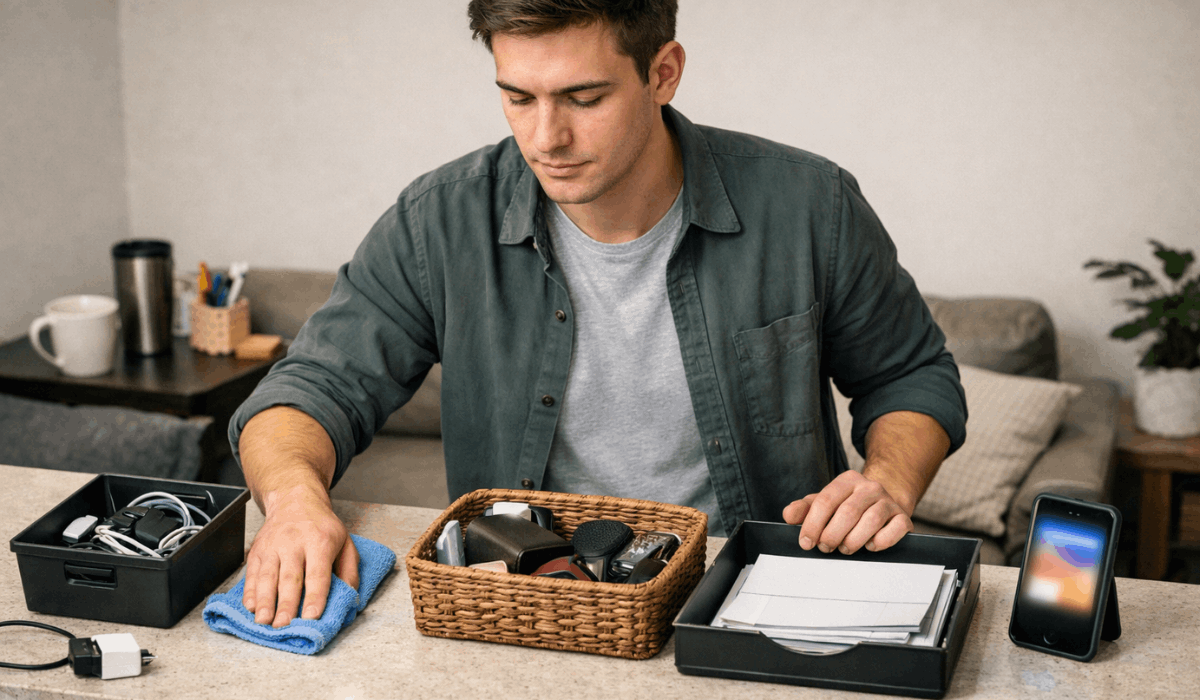
Make the cue physical by using a tray, basket, or placed tool as a start signal your brain recognizes instantly.
My morning routine triggers when I set my coffee mug on the counter. That physical action starts the sequence without requiring any decision or motivation.
Restart Fast After Missing Days
Missing a day does not break a routine unless you delay restarting. You recover faster by returning to the smallest version immediately instead of waiting for motivation to return.
Start with one action by resetting a single surface or area first.
Use the baseline version by skipping extras and completing only the core steps that keep things functional.
Avoid catch-up mode because trying to fix everything at once guarantees overwhelm and another quit cycle.
Resume normal flow by continuing the routine the next day without changes or punishment.
Set a quick win by ending with one visible improvement so restarting feels worth the effort.
Honestly? I think the restart-fast principle saves more routines than any other maintenance strategy because it removes the shame spiral that keeps people frozen after a miss.
Build a Routine Menu for Different Day Types
A routine menu keeps you consistent because you choose a version that matches your day. You keep the same goal and adjust the size so you can still finish.
Create three versions: a normal day routine, a busy day routine, and a low-energy day routine. All three serve the same purpose with different effort levels.
Pick by reality using time and energy as your guide, not guilt or what you think you should be able to do.
Keep the same goal by changing the amount of work, not the purpose of the routine.
Keep steps familiar by reusing the same order across all three versions so switching between them requires zero learning.
Set a minimum finish by defining what complete means for each version so you know when to stop.
Track Consistency Without Adding Another Task
Simple tracking helps you notice patterns without creating more work. Keep it visible so you remember, and measure effort instead of perfection.
Here are tracking methods that take under 30 seconds:
- Use a visible cue like a small card, magnet, or checklist in your routine area
- Track completion fast with one mark per day and no notes required
- Measure effort by counting the days you showed up, even if you only did the baseline
- Keep it honest by never backfilling days you missed
- Review weekly by taking under two minutes to spot what worked and what did not
Protect Your Routine From Interruptions
Interruptions are normal, so you need a routine that can pause and continue without restarting from scratch.
Build short blocks by splitting the routine into parts you can finish quickly before interruption hits.
Set a pause point by choosing one place where you can safely stop without losing progress.
Leave a return cue by keeping one item out that tells you where to resume when you come back.
Resume with the next step instead of restarting from the beginning and wasting energy on repeated work.
Use a fallback option: if interrupted twice, switch to the baseline and finish to maintain the streak.
Use Time Caps to Prevent Routine Expansion
Time limits stop routines from turning into long projects. You work faster and finish more consistently when you know exactly when to stop.
Set a hard limit by choosing a fixed time like 5, 10, or 15 minutes before you start.
Use a visible timer that is simple and easy to start without fiddling with apps or settings.
Stop when time ends by finishing the step you are on and moving on, even if the space is not perfect.
Avoid "just one more thing" by respecting the cap every single time without exception.
Review impact weekly and adjust time only if results are genuinely lacking, not just because it feels incomplete.
Match Routine Size to Your Actual Energy
Energy changes daily, so your routine must adapt without breaking. You stay consistent by scaling effort instead of skipping entirely.
Check energy first before starting so you can decide routine size based on reality.
Lower effort without lowering standards by keeping the same goal with less work.
Avoid forcing full routines when energy is low because consistency matters more than volume.
Use smaller tools or lighter tasks to help yourself start when motivation is absent.
End on a win by finishing with a visible result that makes the effort feel worthwhile.
Call me biased, but I think energy-matching is the most ignored maintenance principle because most productivity advice assumes you wake up with consistent capacity every single day.
Keep Routine Tools in One Dedicated Zone
Searching for supplies breaks momentum and creates excuses. A single tool zone removes delays.
Choose one location and store routine tools together where you use them.
Limit tool count by keeping only what you use, not what you might use someday.
Store at arm level so easy reach encourages action instead of creating barriers.
Return tools immediately by resetting the zone after each routine so it stays ready.
Review monthly to remove unused items and keep the zone light and friction-free.
Reduce Visual Noise That Slows Down Action
Too much visual clutter makes routines feel heavier. A calmer space helps you move faster with less resistance.
Clear one surface fully by starting with your main work area instead of spreading effort thin.
Use closed storage sparingly because hiding everything makes you forget what you own.
Group similar items together so fewer visual categories reduce decision friction.
Limit colors and textures by keeping storage visually quiet and cohesive.
Reset daily with small, fast resets that maintain clarity without requiring deep cleaning sessions.
Build Confidence Through Repetition, Not Motivation
Motivation is unreliable and burns out fast. Repetition builds trust in your system and makes routines feel natural instead of forced.
Repeat the same steps daily because familiarity reduces the effort required.
Track completed days by focusing on showing up consistently, not on achieving perfect results.
Avoid constant changes by letting routines settle for at least two weeks before adjusting anything.
Notice ease over time as effort drops and habits form automatically.
Commit to one routine first so you build confidence before adding more complexity to your system.
The table below shows how routine confidence builds over time with consistent repetition:
| Week | Effort Level | Decision Points | Autopilot Percentage |
| 1-2 | High - requires conscious thought | Every step needs decision | 10-20% |
| 3-4 | Medium - starting to feel familiar | Most steps automatic | 40-60% |
| 5-8 | Low - runs mostly on habit | Only adjustments need thought | 70-85% |
| 9+ | Minimal - fully automatic | Routine feels strange to skip | 90%+ |
Takeaway: Routines become dramatically easier after week three when muscle memory starts carrying the sequence.
Common Mistakes That Kill Routine Maintenance
Some habits feel productive but sabotage consistency.
- Starting too many routines at once overwhelms your capacity and guarantees you will quit all of them within weeks.
- Treating the baseline as failure creates shame around low-energy days instead of celebrating consistency.
- Skipping after one miss turns a single interruption into a complete system collapse.
- Adding steps instead of removing them when routines feel hard makes the problem worse, not better.
- Comparing your routine to someone else's ignores different lives, energy levels, schedules, and support systems.
- Waiting for motivation to restart keeps you frozen indefinitely because motivation never arrives on schedule.
Questions People Ask About Maintaining Daily Routines
Q: How long does it take for a routine to become automatic?
Most routines start feeling easier around week three and approach autopilot by week eight with daily repetition. The key is consistent showing up, not perfect execution. Even doing your baseline version daily builds the habit faster than doing a full routine sporadically.
Q: What if my schedule changes constantly and I cannot do routines at the same time?
Attach routines to events instead of clock times. Morning routine triggers after coffee, not at 7 AM. Evening routine triggers after dinner, not at 6 PM. Event-based triggers survive schedule chaos better than fixed times because the anchor moves with you.
Q: Should I track my routines or just do them?
Light tracking helps you spot patterns without creating burden. One checkmark per day on a visible card shows consistency and motivates continuation. Skip detailed journals and apps that turn tracking into another task you will abandon.
Q: How do I maintain routines when I share space with people who create mess?
Focus your routine on zones you control and one shared high-traffic area with the simplest possible reset. Control what you can, let go of what you cannot, and avoid resentment by lowering expectations of shared spaces.
Q: What is the biggest reason people quit routines they started successfully?
Missing one day, then waiting to restart perfectly instead of immediately doing the baseline version. The quit happens in the waiting period, not the miss itself. Restart fast with minimal effort, and the routine survives.
Stop Waiting for Motivation and Start Building Trust
Daily routines last when they stay simple, flexible, and easy to restart after interruption.
Maintain them by protecting your energy with baseline versions you complete on worst days, reducing decisions through fixed-order sequences, and repeating small actions until muscle memory carries the work.
Choose one baseline routine that takes under five minutes, attach it to an event that already happens daily, like coffee or arriving home, and commit to repeating it tomorrow, regardless of how imperfect today felt.