
Daily flow improves when your routines reduce friction rather than add structure you must manage.
Simple, repeatable actions help you move through tasks with less decision-making and fewer interruptions.
This guide shows how to build practical routines that fit your home, your time, and the way you already live.
What Daily Flow Means in Real Life
Daily flow means moving from one task to the next with minimal hesitation, confusion, or wasted movement.
In real life, it looks like knowing what to do next comes from your routines supporting your space and your habits.
Why Routines Improve Daily Flow
Routines improve daily flow by removing small obstacles that slow you down.
They create a structure that supports action without requiring constant planning or decision-making.
- They reduce decision fatigue by limiting daily choices and automating actions.
- They save time by keeping tasks consistent and predictable.
- They improve transitions between activities, reducing pauses and resets.
- They lower mental stress by replacing reminders with habits.
- They create consistency that helps you maintain momentum even on busy days.
Daily flow improves when your routines reduce friction rather than add structure you must manage.
Simple, repeatable actions help you move through tasks with less decision-making and fewer interruptions.
This guide shows how to build practical routines that fit your home, your time, and the way you already live.
What Daily Flow Means in Real Life
Daily flow means moving from one task to the next with minimal hesitation, confusion, or wasted movement.
In real life, it looks like knowing what to do next comes from your routines supporting your space and your habits.
Why Routines Improve Daily Flow
Routines improve daily flow by removing small obstacles that slow you down.
They create a structure that supports action without requiring constant planning or decision-making.
- They reduce decision fatigue by limiting daily choices and automating actions.
- They save time by keeping tasks consistent and predictable.
- They improve transitions between activities, reducing pauses and resets.
- They lower mental stress by replacing reminders with habits.
- They create consistency that helps you maintain momentum even on busy days.
Start With Fixed Anchors in Your Day
Fixed anchors give your day a stable structure that everything else can build around.
They create predictable points that make it easier to start and maintain routines.
- Wake-up anchor — Begin each day with the same first action to set direction.
- Meal anchors — Use regular meal times to organize tasks before and after eating.
- Work or study anchor — Start focused time with a consistent setup routine.
- Break anchor — Schedule short pauses that reset attention and energy.
- Evening wind-down anchor — End the day with a clear signal that work is finished.
Match Routines to Physical Spaces
Routines work better when they are tied to where actions naturally happen in your home.
Using physical spaces as cues reduces movement, searching, and unnecessary setup.
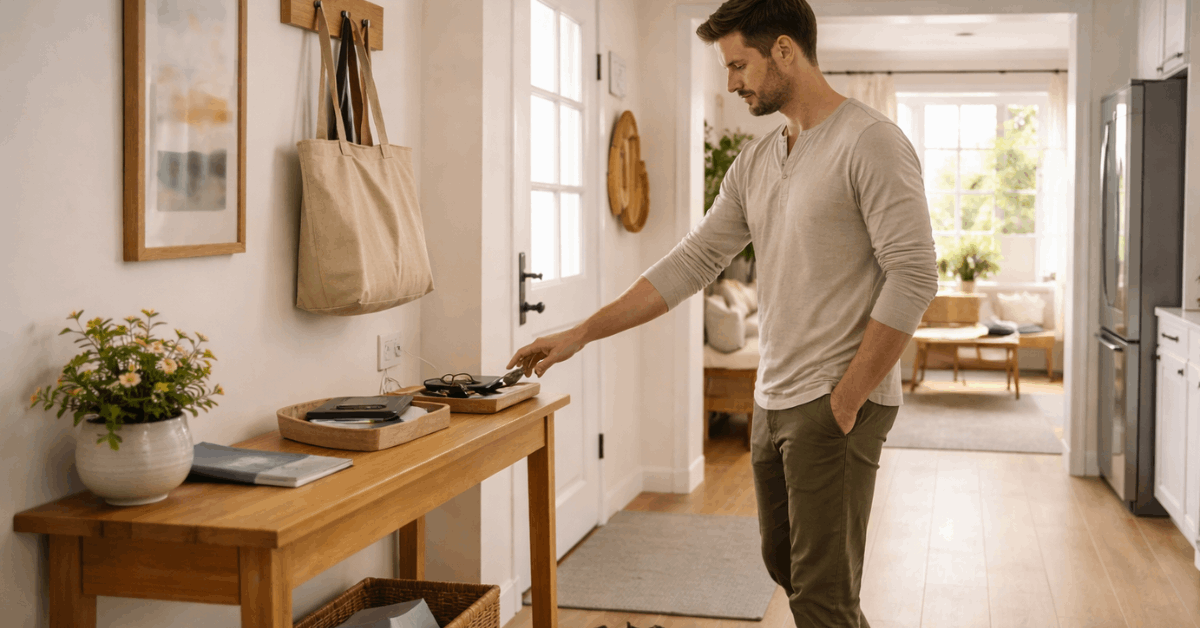
- Entryway routines — Keep keys, bags, and shoes where you leave and pick them up.
- Kitchen routines — Prepare, clean, and reset where food is handled.
- Bathroom routines — Group hygiene tasks to reduce repeated setup.
- Work or study space routines — Start and end focused tasks in the same spot.
- Storage-area routines — Place tools and supplies close to where they are used.
Keep Routines Short and Repeatable
Short routines are easier to remember, easier to repeat, and more likely to stick over time.
Keeping steps to a minimum helps you act without overthinking or resistance.
- Limit routines to a few steps —To reduce mental load and hesitation.
- Focus on one clear purpose —For each routine, instead of combining tasks.
- Repeat routines the same way —To build automatic behavior.
- Remove optional steps —That are not necessary for completion.
- Prioritize consistency over perfection —To maintain daily flow.
Reduce Friction Between Daily Tasks
Daily friction often appears during transitions between tasks, not during the tasks themselves.
Reducing that friction helps you move forward without stopping to reset or rethink.
- Prepare the next task in advance — Set up tools or materials before you need them.
- Use clear end signals — Define when one task is finished so you can move on.
- Keep tools where transitions happen — Place items at the point of use, not just in storage.
- Create short transition routines — Use brief actions to shift focus smoothly.
- Remove unnecessary steps — Cut actions that slow momentum without adding value.
Use Visual Cues to Support Daily Flow
Visual cues support daily flow by reminding you what to do without relying on memory or alarms.
They guide action through placement and visibility rather than instructions.
- Place items in plain sight — Visible objects naturally prompt the next action.
- Group related items together — Visual order reduces searching and delays.
- Use open storage for daily tools — Accessibility supports faster starts.
- Position cues at transition points — Reminders work best where decisions happen.
- Remove visual clutter — Fewer distractions make cues more effective.
Standardize Repetitive Daily Tasks
Standardizing repetitive tasks reduces effort by removing the small decisions you make every day.
Doing things the same way each time helps maintain speed and consistency.
- Use the same steps each time — Repetition builds automatic action.
- Choose one preferred method — Avoid switching approaches without reason.
- Keep tools in fixed locations — Consistency reduces setup time.
- Follow the same order of actions — Predictable sequences improve flow.
- Simplify whenever possible — Fewer variations mean fewer interruptions.

Add Small Reset Routines During the Day
Small reset routines help prevent clutter, fatigue, and mental overload from building up during the day.
Short resets keep your environment and attention clear without stopping productivity.
- Do quick space resets — Return items to their place after use.
- Use brief movement breaks — Stand, stretch, or walk for a minute.
- Clear your work surface — Remove unnecessary items between tasks.
- Reset your focus — Pause briefly before starting the next activity.
- Schedule natural reset points — Link resets to meals or transitions.
Limit the Number of Active Routines
Too many routines compete for attention, making daily flow harder to maintain.
Fewer active routines allow you to focus and follow through without overwhelm.
- Prioritize essential routines — Keep only what supports daily function.
- Pause low-impact routines — Remove habits that do not add value.
- Introduce routines gradually — Add one at a time to avoid overload.
- Review routines regularly — Adjust based on what you actually use.
- Protect mental capacity — Fewer routines mean clearer decisions.
Adjust Routines When Life Changes
Routines must change as your schedule, responsibilities, and environment change.
Adjusting them keeps the daily flow realistic instead of restrictive.
- Reevaluate routines after schedule shifts — Work hours, school, or travel matter.
- Simplify during busy periods — Reduce steps when time is limited.
- Move routines to new spaces — Adapt to layout or location changes.
- Update timing, not structure — Keep the routine, but shift when it happens.
- Let go of routines that no longer fit — Consistency should support life, not fight it.
Common Mistakes That Disrupt Daily Flow
Daily flow breaks down when routines put pressure rather than support.
These common mistakes add friction and make simple days harder than they need to be.
- Overloading routines with too many steps — Complexity reduces follow-through.
- Copying routines that do not fit your life — Mismatch leads to failure.
- Ignoring physical space limitations — Poor placement slows action.
- Trying to be perfect every day — Rigidity disrupts consistency.
- Not reviewing routines over time — Outdated habits lose effectiveness.
To Sum Up
Daily flow improves when routines support how you move, think, and use your space.
Simple, repeatable actions create momentum without adding pressure or complexity.
Start with one routine today and adjust it until it fits your real life.